
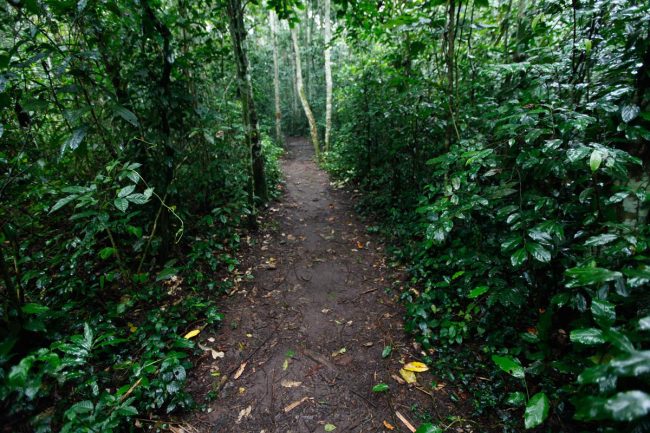
Discover the mystical Mabira Forest, located in Buikwe District, about 26 kilometers west of Jinja and 56 kilometers from Kampala. Mabira Forest Reserve is located on the Kampala-Jinja Highway. It is one of the few tropical rainforests that are left on the African continent. Mabira Central Forest Reserve covers an area of 306 square kilometers and is inhabited by a diversity of species. It was designated a Forest Reserve in 1932 and is largely comprised of semi-evergreen rainforest. Mabira Forest lies in the Victoria Basin eco-region, Central Uganda. It is among the scenic natural forests that are managed by the National Forest Authority (NFA).
What to see on the Uganda tour in Mabira Forest?
Primates
Mabira Forest holds a diversity of primate species. Mabira’s diverse primates include the red-tailed monkeys, baboons, grey-cheeked mangabeys, vervet monkeys, Uganda Mangabeys, and black & white colobus monkeys. Overall, Mabira contains about 35 mammal species. These include squirrels, duikers, and bushbucks. It also has about 316 bird species, 97 moths, and 219 species of butterflies.
Birds in Mabira Forest
A total of about 316 bird species reside in Mabira Forest Reserve. These include the African pygmy-goose, white-crested turacos, red-chested flufftail, African cuckoo-hawks, Egyptian vultures, Northern red-bishops, lesser jacanas, white-tailed ant-thrush, gray-headed bush shrikes, and Goliath heron. Mabira is also home to birds. These include western banded snake-eagle, square-tailed nightjar, greater honey guide, pied cuckoos, olive-green camaroptera, white-chinned prinia, Northern crombec, Moustached grass-warblers, Gray long bill, buff-bellied warblers, tit-hylia, western nicator, Carruthers’s cisticola, black-throated apalis, tabora cisticola, croaking cisticola, tawny-flanked prinia, and lesser bristle bill.
Additional bird checklist in Mabira includes slender-billed greenbul, common reed warblers, violet-backed starling, purple starling, splendid starling, brown babbler, African stonechat, swamp flycatchers, pale flycatchers, little weaver, Bronze sunbird, copper sunbird, slender-billed weaver, scarlet-chested sunbird, superb sunbird, and red-headed malimbe.
Activities to do in Mabira Forest
Top things to enjoy on a Uganda safari in Mabira Forest Reserve. For example, birding tours, forest walks, zip-lining, mountain biking, mangabey trekking, and more. Below is a detailed list of experiences or activities in Mabira Forest, Uganda;
Birding
When it comes to birding, Mabira never disappoints bird enthusiasts. Keen bird-watchers have a great opportunity to identify the diversity of the resident forest. The endemic birds on a guided birding tour in Mabira Forest.
The bird checklist in Mabira Forest Reserve includes yellow-crowned canary, black collared apalis, African blue flycatchers, copper sunbird, scarlet-chested sunbirds, green-headed sunbirds, little sunbird, red-headed malimbe, slender-billed weaver, bronze sunbird, gray-headed sunbird, baglafetch weaver birds, compact weaver bird, golden-backed weavers, superb sunbird, cardinal quelea, yellow-throated long claw, black-bellied seed cracker, common waxbill, African fire finch, plain-backed pipit, pin-tailed whydahs, and African pied wagtail.
Lizard buzzard, Wahlberg’s eagle, African hawk-eagle, Augur buzzard, Gabar goshawks, Cassin’s hawk-eagle, African marsh harrier, freckled nightjars, African emerald cuckoos, and many more. During a guided birding excursion, expect to explore the different trails with an experienced guide. Each birding trail promises you astonishing bird sightings and other species, including floral species. Birders on Mabira bird-watching tours can opt to embark on the morning or afternoon session.
Primate viewing
A primate viewing tour offers visitors a unique opportunity to explore the diversity of primates. These survive in the lush Mabira rainforest. Expect to find the playful baboons, colobus monkeys, grey-cheeked mangabeys, and red-tailed monkeys.
Zip-lining
Zip-lining shouldn’t be excluded from your checklist of experiences to enjoy in Mabira. A zip-lining experience is possible to be enjoyed during the morning or afternoon. The morning session begins at around 8:00 am, and the afternoon expected to begin at 1:00 pm. The zip-line in Mabira was built by the USA Peace Corps and is operated by experienced experts. Each session costs UGX 60,000 (Ugandans) and USD 50 for foreign residents.
Mountain biking
Expect to explore the enriching mountain biking trails through the lush rainforest. During biking sessions, you will get a chance to navigate via the various trails, including those in the nearby communities. Visitors can hire mountain bikes at Griffin Falls camp. A normal biking excursion can last for about 4 hours, but expect to return when filled with lasting memories.
Mangabey trekking
Guided mangabey trekking offers an exceptional opportunity for you to explore more about the unique grey-cheeked mangabey monkeys. These are among the oldest monkey species and thrive in Mabira Forest and some parts of Tanzania. In 2018, they were listed among the vulnerable species. On a mangabey trekking tour in Mabira, expect to embark on a search for the 3 habituated groups of this monkey species, and you can be led by an experienced guide. Other species will also be spotted, including birds, floral species, and butterfly species.
Camping experience
Camping in Mabira offers a deep connection with nature. This is done around Griffin Falls camp, located along the edge of the forest, about 10 kilometers from the Kampala-Jinja highway. It is also possible to go camping at the main eco-tourism site in Mabira Forest. The beauty of camping excursions is that you can enjoy the melodious forest bird songs and watch the free-roaming Mabira species.
The Best time to explore Mabira
Mabira Central Forest Reserve is open to guests all year round, although the dry months offer excellent conditions for nature walks or mangabey monkey trekking. This often begins from June, July, August, to September, while the second dry spell usually commences from December, January, to February. These months experience less rain, and most of the trails in Mabira can easily be explored by visitors. Heavy rains with the ground being muddy or slippery, plus dense undergrowth, are often recorded around the wet or rainy season, which occurs from March to May, then from October to November.
Where to stay?
The accommodation options present for visitor overnight stay in Mabira Forest include the Rain Forest Lodge, camping, and Griffin Falls Camp. Visitors can also stay in the hotels in the adjacent towns like Lugazi and Jinja.
Getting there
Mabira Forest Reserve is accessible by road, and you can drive on the Kampala-Jinja highway for 56 kilometers. The Reserve lies in the Eastern part of Kampala, and you can drive via Seeta, Mukono, and Lugazi. About 1.5 hours’ drive can be spent to reach Mabira Forest.