
Many have talked about Bwindi Impenetrable National Park, but few have addressed the visitors’ concerns they put across when coming to Bwindi. Such pressing concerns leave visitors with less knowledge about their destination, and answering some of the most frequently asked questions.
What we have always prioritized as Monteero Safaris is for visitors to expect the unexpected in a thrilling moment. This is not just with the mountain gorillas, but with culture and the vast nature, while maintaining the safety of visitors. Many companies fix their attention on the mountain gorillas alone. However, this limits Bwindi’s capacity as an adventurous jungle of opportunities.
With many years of experience in taking visitors to experience the secrets of Bwindi Impenetrable National Park, we have strengthened the client’s perception of this jungle. Other than the mountain gorillas, visitors often ask a lot about different topics that surround Bwindi Impenetrable National Park.
First, such questions appeared to be more of curiosity, but the constant repetition of these questions by different visitors marked them as a point to address. This is why we have noted a couple of them and detailed them for everyone to understand. This is through a complete guide to visiting Bwindi Impenetrable National Park.
For a complete guide to visiting Bwindi Impenetrable National Park, we have rounded up some of the pressing questions that visitors usually ask about. Based on these questions, a whole picture of Bwindi Impenetrable National Park is brought to life. Below are some of these questions.
How big is Bwindi Impenetrable National Park?
Bwindi Impenetrable National Park stretches for over 331 square kilometers. It is not the biggest destination in Uganda, but it has an untouched jungle that dates back over 25,000 years. Bwindi Impenetrable National Park’s size stretches across the districts of Kabale, Kisoro, and Kanungu. The park is close to the border with the Democratic Republic of Congo, forming an extension of the Virunga Conservation Area. The park’s strategic location forms an eye-catching scenic beauty of the Virunga Massif.
How many mountain gorillas are in Bwindi Impenetrable National Park?
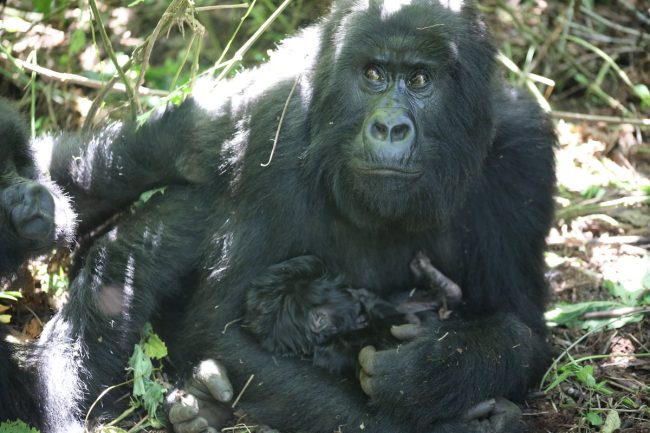
Bwindi Impenetrable National Park hosts over 460 mountain gorillas. This equates to close to half of the world’s mountain gorilla population of over 1,063 gorillas. Bwindi hosts the most mountain gorillas in the entire world. This is why it is the most popular and highly visited gorilla destination in the world.
Are the mountain gorillas the only attraction in Bwindi?
The mountain gorillas are the major tourist attraction in Bwindi Impenetrable National Park, but certainly not the only attraction. Bwindi is home to over 400 bird species and includes both the migratory and the endemic resident birds. Birding alone invites adventure enthusiasts and nature lovers to embark on a birding experience through the birding trails of Mubwindi and River Ivy in the Ruhija sector.
The Batwa cultural experience is another fun and unique experience of visiting and interacting with the Batwa local communities. The Batwa pygmies are some of the oldest pygmy groups in Africa, and they live in the neighbouring communities across Bwindi. These Batwa people lived in the forest of Bwindi before being forced out to gazette the forest as a national park.
What are the chances of encountering the mountain gorillas?
Although nature dictates its way, there are very high chances of encountering mountain gorillas in Bwindi Impenetrable National Park. From the time mountain gorilla trekking in Bwindi Impenetrable National Park was introduced, there has not been a time when visitors didn’t encounter these mountain gorillas. Over 90% of the time, visitors have navigated the forest of Bwindi have managed to encounter the mountain gorillas. However, there is always that 10% since nature cannot be tamed, but the expectations are always positive.
What happens when you don’t see the mountain gorillas in Bwindi?
The Uganda Wildlife Authority, as a managing body, understands that sometimes nature can be undesirable and fall far short of expectations; this is why visitors are given another chance to trek the gorillas at zero cost. The mountain gorillas in Bwindi are untamed, therefore very mobile in their natural habitat. No one limits their movements, although they are constantly monitored as a conservation effort. Hence, visitors are sure to encounter these primates.
How many gorilla families are in Bwindi Impenetrable National Park?
There are over 50 mountain gorilla families in Bwindi Impenetrable National Park. However, about half of these are habituated. Approximately 26 gorilla families are available daily for trekking. Mountain gorillas are social animals that live in groups called families, and these groups are headed by a dominant male gorilla called a silverback.
Are mountain gorillas in Bwindi dangerous to humans?
Mountain gorillas in Bwindi are generally not dangerous to humans since they are habituated and accustomed to humans. This question of whether mountain gorillas are dangerous to humans is often asked, especially by first-time visitors to Bwindi. Safety is always the priority, and this is why gorilla trekking is done under the guidance of rangers. Through a pre-briefing on the rules and regulations of gorilla trekking, visitors are also informed on what to do in rare cases of mountain gorillas portraying aggression.
Can chimpanzee trekking be done in Bwindi Impenetrable National Park?
No, chimpanzee trekking is not done in Bwindi Impenetrable National Park. This question is also frequently asked, but chimpanzee trekking is not approved in Bwindi. This means that although Bwindi Impenetrable National Park hosts over 600 chimpanzees, trekking these primates is not yet possible.
This is because the government bodies responsible for management have not yet conducted an assessment of these chimpanzee communities. Chimpanzee trekking can, however, be done in Kibale Forest National Park, Kyambura Gorge located in Queen Elizabeth, Kalinzu Forest, and Budongo Forest in Murchison Falls National Park, among others.
What is the best gorilla sector in Bwindi Impenetrable National Park?
The best gorilla sector in Bwindi depends on the particular gorilla trekking experience a visitor desires. For smooth and short treks, Buhoma, the founding gorilla sector in Bwindi, is the best, and it also has the infrastructure. Tough and challenging terrain, Nkuringo and Rushaga are favorites, and also with numbers, Rushaga takes the lead. Ruhija offers an additional sightseeing experience of the Virunga ranges of the Congo.
Why is gorilla trekking in Bwindi expensive?
What makes gorilla trekking in Bwindi expensive is that the conservation efforts undertaken to protect the mountain gorillas are in their natural habitats. A big percentage of the gorilla permit costs is dedicated to conservation, and this is why mountain gorillas have moved from critically endangered to endangered species as listed by the IUCN Red List.
Gorilla trekking is valued at over USD 800 for foreign non-residents, USD 700 for foreign residents, USD 500 for visitors from the rest of Africa, and UGX 300,000 for East Africans. These costs are collected through the purchase of gorilla permits. However, there are also discounted low-season permits for budget travellers to have a chance to trek gorillas.
Can I do gorilla trekking in the wet season?
Yes, you can do gorilla trekking in the wet season, although the dry season is always considered the best gorilla trekking season. The wet season is a time characterized by prolonged rains and short sunshine periods. Such conditions can be challenging for visitors on gorilla trekking.
Nevertheless, gorilla trekking is possible in the wet season in Bwindi Impenetrable National Park. The weather in Uganda is very unpredictable, as it can shine harshly in the wet season, with less rain. Therefore, gorilla trekking in the wet season is very possible and offers an untamed experience.