
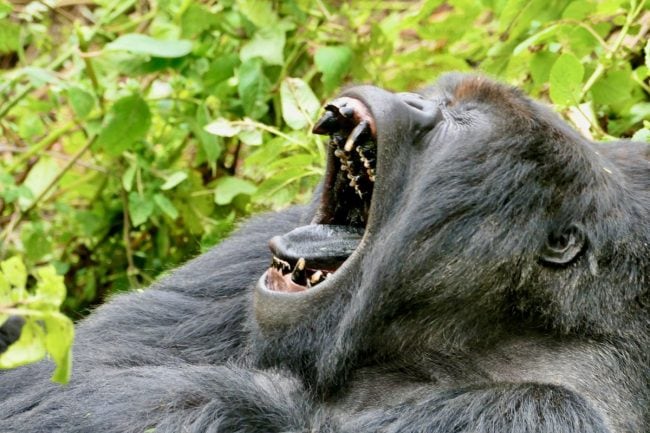
Mountain gorillas, by their nature, are generally not dangerous to humans nor even show aggressive traits in the presence of humans. This question about the aggression or danger of gorillas to humans is an instinctive, commonly asked one, especially for visitors set to embark on a gorilla experience. Although mountain gorillas are wild animals with very unpredictable behaviours, on rare occasions, they do show their wild or aggressive side to humans. Nevertheless, humans must at all costs respect their space and follow the rules and regulations or guidelines set by the custodians of most of these gorilla destinations.
Is it safe to visit mountain gorillas in their natural environment?
Yes, it is very safe to visit mountain gorillas in their natural environment, provided visitors follow the set guidelines during a pre-trekking briefing. All mountain gorilla groups that are identified for exploration have gone through a habituation process.
This habituation process refers to the act of gently customizing or familiarizing human presences to the wild mountain gorillas. This gorilla habituation process takes about 3-4 years, depending on the character of the gorillas in the targeted gorilla family or group. The gorilla habituation experience lasts for over 4 hours per day for these primates to get used to human presence. This habituation is carried out by researchers, scientists, rangers, and sometimes visitors. They study the behaviours of the specific gorilla group and identify its members. They also collect stool samples for further research back at their laboratories.
When do mountain gorillas become aggressive or dangerous to humans?
Mountain gorillas usually become aggressive or dangerous to humans when they feel threatened. These primates are generally very shy, calm, and gentle, but this should not fool you, as behind that shy look, these gorillas have incredible strength and one of the most powerful bites in the animal kingdom. This is why it is essential to always respect them and adhere to the set guidelines. However, these gorillas spend much time with the rangers, trackers, and visitors, and therefore get used to them.
Sometimes people may disturb their peaceful nature by mimicking aggressive or threatening behaviour like chest pounding. This is a very dangerous game and can really bring out the dangerous and aggressive side of the mountain gorillas, especially the silverback. This specific behaviour is interpreted as a challenge to the silverback. Even then, the silverback does not usually charge at you but instead first warns by making signals of aggression like small groans and displaying its long canines.
It is also important to note that mountain gorillas may not necessarily be aggressive to humans but to their own kind. It is very common that mountain gorillas, especially the silverback, portray significant aggression towards another silverback. This is in serious situations, such as fights for mating rights and dominance in the gorilla family.
Such fights are very lethal and usually cause injury, and sometimes the defeated silverback pays with their life. It is very sad when a silverback is killed in the line of battle for dominance, but that is how nature operates, and it is called the circle of life.
How to avoid a gorilla attack in case faced with one?
Gorilla attacks on humans are rare and hardly documented. However, they sometimes happen, like there is a case where a poacher was killed by a massive silverback when he tried to attack it. Therefore, here are some tips on how to avoid a gorilla attack in case faced with one.
- Do not mimic the sounds of the mountain gorillas or even imitate their behaviours. Visitors must know that we humans don’t speak primate language, therefore don’t understand what they mean. It is important not to mimic or imitate them as some behaviours or sounds can mean threats or aggression, thus triggering a burst of aggression from the silverback.
- Always avoid direct eye contact with the mountain gorillas, especially the silverbacks. Direct eye contact with gorillas is perceived as a direct challenge and therefore can force the silverback into defensive aggression.
- Avoid making yourself appear tall in case a silverback charges at you. Standing tall means you appear aggressive and a challenge to the silverback. Therefore, when a silverback charges at you, squat down and make yourself appear very small. This is a way of submission to the gorilla.
- In case of a gorilla attack, do not run because you cannot outrun a gorilla. Mountain gorillas are adapted to their environment, therefore can move very quickly through even the densest vegetation. Running is never an option when the silverback is charging at you, since you cannot outrun it.
- You must follow the set rules and regulations when encountering the mountain gorillas. This probably should be the number one rule, since it is better to avoid a gorilla attack than to control an attack when it happens.
Where to encounter mountain gorillas?
The process of encountering and spending an hour with the mountain gorillas is called gorilla trekking. There are designated gorilla destinations where mountain gorillas can be encountered, and these include the following.
Bwindi Impenetrable National Park
At the peak of all the gorilla destinations sits Bwindi Impenetrable National Park, situated in southwestern Uganda. This ultimate gorilla destination offers an undisputed gorilla trekking experience. Visitors to Bwindi have a chance to also participate in the gorilla habituation experience, since it is the only destination offering it. The park harbors 500 gorillas, equalling close to half of the total world population. Over 50 gorilla families are here, but only half of these are habituated and available for trekking. Gorilla trekking takes place through four gorilla sectors of Buhoma, Rushaga, which also offers habituation, Nkuringo, and Ruhija.
Volcanoes National Park
Situated close to Uganda and the Democratic Republic of Congo, Rwanda’s Volcanoes National Park is also a famous gorilla destination. This park offers a luxury gorilla trekking experience with over 13 gorilla families up for exploration. This park is managed by the Rwanda Development Board.
Mgahinga Gorilla National Park
Uganda is fortunate to have two gorilla destinations, i.e., Bwindi and Mgahinga Gorilla National Park. This park is located in the southwestern region of Uganda in Kisoro district. It is the smallest park in the country, spanning over 33.7 square kilometers. However, what this park lacks in size it makes up for in adventure by offering a private gorilla trekking experience. This park harbors only a single gorilla family called Nyakagezi. It is managed by the Uganda Wildlife Authority. It was established in 1991 and became a UNESCO World Heritage Site in 2007.
Conclusively, mountain gorillas are an endangered primate species as listed by the IUCN, and thus must be conserved and protected. This is why avoiding triggering their aggressive side is also a form of conservation since it reduces stressing them. Contact Monteero Safari for an exclusive gorilla experience in any of the gorilla destinations of your choice.