
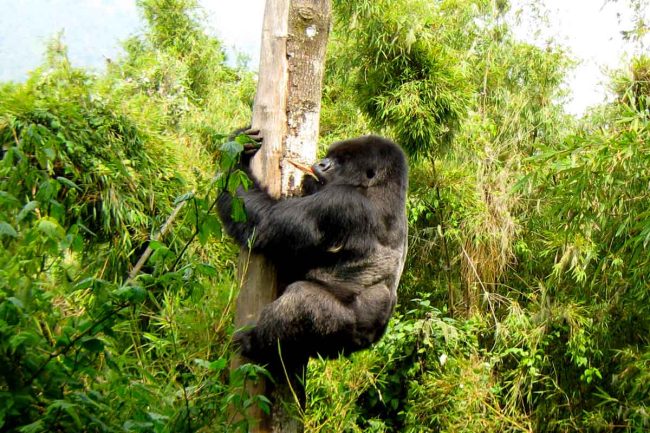
This is one of the most asked questions by most visitors preparing for a gorilla tour in Africa. Being fit may not be an actual requirement for trekking gorillas, but it is surely necessary for a successful one. There is no definite scale for measuring the fitness of someone to embark on a gorilla trekking experience. However, it is worth understanding that one should be fit enough to venture through tight, steep, and rugged terrain.
On this account, one should be moderately fit to participate in a gorilla trekking experience. You may not need to train as a marathon runner or an athlete for this gorilla trek. However, visitors need to prepare to walk for longer hours, about 3-7 hours, through uneven, steep terrain on muddy and slippery trails.
How difficult is gorilla trekking?
Gorilla trekking is not a very difficult activity, but it is one that requires a certain level of preparation. The difficulty of gorilla trekking as an activity is measured by the scale of the terrain of a particular gorilla destination. Each gorilla destination portrays a unique terrain that may pose a challenge to even the most skilled trekkers.
Therefore, the gorilla trekking adventure is only as difficult as the gorilla destination. However, it is also worth noting that the terrain alone does not make up for difficulty. The denseness of the vegetation and the slipperiness of the trekking trails also add to the difficulty. Therefore, the difficulty level of gorilla trekking is more of a combination of the thickness of vegetation, steepness of the terrain, and the slipperiness of the trails.
How long is gorilla trekking?
Gorilla trekking does not have a distinct duration, and this is mainly because of many underlying factors. Some of these factors include the following.
- Mobility of mountain gorillas
Mountain gorillas are mobile animals that constantly move across their territories. Therefore, their mobility influences the duration one requires to trek these mountain gorillas. As these primates extend further into their territory, it makes the trekking experience longer. However, if the gorillas move closer, it shortens the duration of the gorilla trekking.
- Terrain of the destination
Mountain gorillas live in a mountainous area, and their terrain is a little bit steep. This particular type of terrain affects the duration of the trekking adventure, making it longer.
- Weather/climate
The weather or climate is an important factor in the duration of the gorilla trekking experience. Dry weather affects the vegetation by leaving it sparse and the trekking trails dry, which increases visibility and eases navigation. This makes the trekking duration shorter since there are few obstructions. Wet weather, on the other hand, increases the duration since the trails are slippery, hindering navigation, and the dense vegetation reduces visibility.
- Allocation of the gorilla family
All gorilla destinations harbor different gorilla families distributed across different directions. Visitors allocated to a distant gorilla family will spend longer hours searching for the gorilla family than those allocated to a closer gorilla family.
Where to do gorilla trekking?
Gorilla trekking is only done in Africa and not anywhere else in the world. This is because Africa is the only continent with fitting conditions for the mountain gorillas to thrive. There are not many places to do gorilla trekking since East Africa is the only region gifted for this particular activity. Below are some of these places where gorilla trekking is done.
Bwindi Impenetrable National Park
Mentioning gorilla trekking and excluding Bwindi is really leaving this topic incomplete. This is because Bwindi Impenetrable National Park is the icon of gorilla trekking in the world. This park qualifies as the best gorilla destination. This conclusion comes up as a distinct description of Bwindi since it hosts the largest number of mountain gorillas. Over 459 individual mountain gorillas are recorded in this park, the most for any destination.
With such a large number, Bwindi’s population of gorillas equates to close to half of the world’s population of 1,062. These gorillas in this park are scattered across its four sectors of Buhoma, Rushaga, Nkuringo, and Ruhija. This park was established in 1991 as a national park from a crown forest reserve. In 1994, this park was recognized as a UNESCO World Heritage Site. It is located in the southwestern region of Uganda.
Volcanoes National Park
This park is Rwanda’s iconic gorilla destination, situated in the northern region. Volcanoes National Park was established way back in 1925, making it one of the oldest parks on the continent. Volcanoes National Park hosts over 300 mountain gorillas and is a popular gorilla destination known for luxury gorilla tours. It is located on the border with the Democratic Republic of Congo and Uganda. It hosts over 10 habituated gorilla families that can be trekked daily.
Mgahinga Gorilla National Park
Mgahinga Gorilla National Park is the second gorilla destination located in Uganda after Bwindi. It was gazetted in 1991 after the discovery of mountain gorillas. It is the smallest gorilla destination with just 33.7 square kilometers. Over 100 mountain gorillas are recorded to be living in this destination. This enriched gorilla territory is perfect for visitors interested in less challenging terrain.
Virunga National Park
Another gorilla destination often left behind is Virunga National Park. This is believed to be the mother destination for all gorilla destinations. This park is where the Virunga Conservation Area, the last known gorilla conservation area that encompasses all the gorilla destinations, draws its name. Located in the Democratic Republic of Congo, Virunga National Park is one of the least visited among all the destinations. This is because it is located in an area that is politically unstable. It was gazetted in 1925 and is the largest gorilla destination with over 7,800 square kilometers. It is estimated that it harbors about 250 mountain gorillas.
The above destinations are the only places where one can find mountain gorillas in their natural habitats worldwide. Fitness can be a factor in a successful gorilla trekking experience, but other external factors like terrain and weather also affect the experience. Get in touch with an expert tour operator like Monteero Safaris for more details on gorilla trekking and how to go for a gorilla trekking experience.