
Overview
The Big 5 safaris in Rwanda are a journey that will drive you to Akagera National Park. This is the only park that hosts Africa’s Big 5 at the same time. These Big 5 animals include elephants, Cape buffalo, lions, leopards, and rhinos. Rwanda is ranked the cleanest country with the most organized capital city, Kigali, in the whole of East Africa. It is known as the land of a thousand hills due to its landscape and terrain. Rwanda is so interesting to visit, with its four national parks. Among these, Akagera National Park is the biggest harboring over 8000 wildlife.
Brief history of Akagera National Park
Akagera National Park is one of Africa’s biggest national parks and was established in 1934. It is located in the eastern part of Rwanda and covers an area of 1,122 square kilometers. The Belgian government gazetted Akagera National Park spanning 2,500 square kilometers. This was set up to purposely protect the spectacular biodiversity of flora and fauna. It was nicknamed “Parc aux Lycanos,” a French statement meaning park of Lycanos.
Wildlife in Akagera lived a peaceful life until rampant poaching of the wildlife and land encroachment by the local people. Deforestation and farming led the animals to begin moving to the nearby national parks. This was not enough; the long, tragic period of the Rwandan genocide of 1994 led to the massive killing of the wildlife, and most of them became almost critically endangered and extinct.
In 1994, as the genocide ended, the few that were left were again displaced, reducing the parkland from 2,500 to 1,122square kilometers. This land was used to resettle the refugees of the genocide, farming, and cattle grazing activities. This always created insecurity for the few wildlife that existed at that period, as they could still be hunted down by poachers.
Management of Akagera
The African Parks, which was a conservation NGO, joined efforts with the Rwanda Development Board in 2009. This partnership aimed to conserve Akagera National Park once again, forming the Akagera Management Board in 2010.
The management since then has ensured the protection of the wildlife. It has also increased the critically endangered species by translocating some of them from South Africa. This helped the animals multiply, among other efforts. Today, Akagera National Park hosts 500 bird species, about 130 savannah elephants, and around 20 leopards. There are also over 20 black rhinos, 58 lions, over 85 Rothschild giraffes, 2093 buffalos, 1,057 impalas, 998 zebras, and 950 waterbucks, among other wildlife.
Africa’s Big 5 in Akagera National Park
Akagera National Park is the only park in Rwanda that hosts all of Africa’s big 5. These were at first lost in the Rwandan genocide. However, the buffaloes stayed due to their temper and dangerous nature, with their large numbers. The big 5 are on the increase, attracting several tourists to Akagera National Park.
The African Elephants
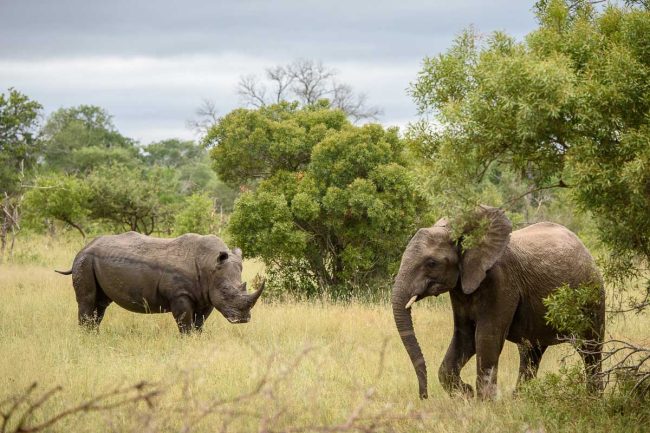
Elephants in Akagera National Park were under threat of extinction during the period of the Rwandan genocide of 1994. This is when they were hunted for their tusks. Many elephants were also killed after the refugees took over two-thirds of the park for settlement and cattle grazing. Later in 1975, over 26 elephant calves were translocated from South Africa to Akagera. This led to an increase in the number of elephants to 130 individuals in the park.
Lions
Lions are well-known kings of the jungle all over the world. They are thought to be the strongest with the loudest roar in the wild. Akagera National Park hosts about 58 lions today after the long-time struggles of restoring them in the park by African Parks. Seven lions were transferred from South Africa in 2015 to increase their population. This is due to the favorable and conducive atmosphere; these survived and multiplied. More of the lions were brought into Akagera in 2017. The current census report, Akagera National Park hosts about 58 lions.
Cape buffalos
The cape buffalos are very many in number more than all other big 5 due to their untold temper that was difficult and dangerous for the poachers to hunt them. Buffalos are social animals living in a group called a herd and can easily attack in case they sense any danger anywhere. They always have high concentration marking Akagera with 2093 buffalo individuals.
Leopards
Leopards are among the deadliest animals and are difficult to spot, as they often stay in tree branches and hide in tall grass in search of prey. They are so unique with short legs and long, spotted bodies that are very attractive to watch. Leopards are very few in number, with only 20 individuals in Akagera National Park, since females give birth to only one cub at a time and the chances of females reproducing are very low.
Rhinos
Rhinos were long lost for about 10 years after the Rwanda genocide only to be restored in 2017 when 18 black eastern rhinos were relocated from South Africa to Akagera National Park by the African parks in conjunction with the Rwanda Development Board. More were introduced in 2019 increasing the Rhinos to 20 individuals.
When is the best time for Africa’s big 5 safaris?
Akagera National Park is open year-round and most preferable in early September since this is a peak season as well as late June. The dry season allows tourists to easily spot the wildlife when the vegetation is sparse and all animals are concentrated by the lakes. From June to August, it is a dry season as well however, rainfall is received in less amounts making it a perfect time for the safari photography and game drives. This season balances both dry and wet offering a spectacular view of the biodiversity in Akagera National Park.
The other months of March, April, May, October, and November are wet most especially afternoon and evening hours making game drives and guided nature walks preferable only in the morning hours.