
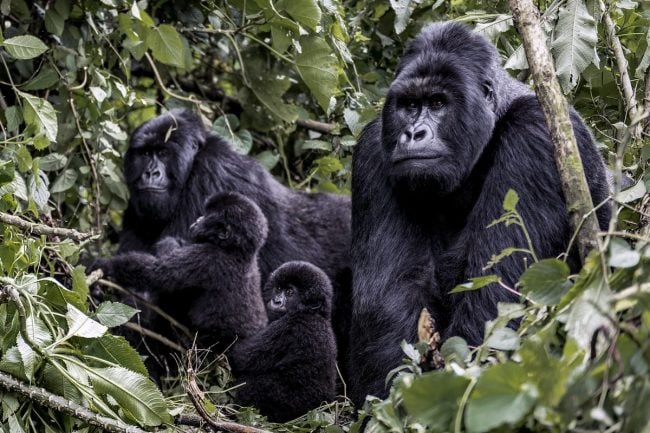
Gorilla habituation is the art of familiarizing wild mountain gorillas with human beings in their natural habitat while maintaining their natural behaviours. The sole purpose of this gorilla habituation activity is to gently prepare the mountain gorillas for gorilla trekking. Gorilla habituation is a very essential part of all gorilla tours. It is regarded as the foundation of gorilla activities.
The process of gorilla habituation is carried out by a group of skilled rangers, researchers, and scientists accompanied by a few visitors. The gorilla habituation experience lasts for over 4 hours per session. This enables the mountain gorillas to see humans as neutral parties rather than intruders or as a threat. From the start of the habituation process of a particular gorilla group, the gorillas stare at the humans in alertness and feed conscientiously while watching the humans.
In the middle stages of the habituation process, the gorillas look at humans quickly, continue with their daily chores while maintaining a specific distance from them. Towards the last stages of gorilla habituation, the gorillas are now accustomed to humans and can continue with their chores and even come close to them. This is when the particular gorilla group is declared habituated and ready for trekking. However, this process is repetitive over a specific period of time until positive results are confirmed.
How long does gorilla habituation last?
Gorilla habituation is a relatively long process that lasts anywhere from 2 to 3 years. Such a period is precisely with gorilla groups that are friendlier. The gorilla habituation process, however, is sometimes pushed to 5 years if the gorilla family is more aggressive toward outsiders, as they perceive them as intruders. In other words, the character and behaviour of the gorilla families targeted for habituation determine how long the gorilla habituation process will last.
Where is gorilla habituation done?
Gorilla habituation is a rare tourist activity that is only done in the Rushaga gorilla sector of Bwindi Impenetrable National Park. This sector comes second to none in offering unmatched gorilla habituation experiences. This activity is only offered at this sector and not anywhere else in the park, but also in all the other gorilla destinations. The Rushaga gorilla sector is the only designated place for gorilla habituation. Because of this, many usually ask why gorilla habituation is limited to Rushaga. A few reasons can be marked out as follows.
- The number of unhabituated mountain gorillas
- Size of the gorilla destination
- Costs involved in habituation
- Specialized personnel like scientists and researchers, etc.
How much is gorilla habituation?
The pricing of gorilla habituation is tagged on the nationality and region of the visitors. Categorized under international or foreign non-residents who pay USD 1,500, foreign residents USD 1,000, the Rest of Africa at USD 1,000, and East African citizens and nationals at UGX 750,000. It is important to note that this particular pricing is valid up until the end of the year 2026. Effective 1st January 2027, there will be a new gorilla habituation pricing, and this will see a slight increase. Both foreign non-residents and residents will be required to pay USD 1,800 and USD 1,600, respectively, for a gorilla habituation experience.
What is the difference between gorilla trekking and habituation?
By definition, gorilla trekking is the process of navigating across the dense gorilla destinations to encounter gorillas and spend an hour in their presence. The standard gorilla trekking is a result of the habituation process done on a particular gorilla group for a specific period. There are a few underlying differences between gorilla trekking and gorilla habituation. These include the following.
| Differences | Gorilla trekking | Gorilla habituation |
| Time/period sent with the gorillas | One hour | Four hours |
| Number of visitors | Eight | Four |
| Destination/sector | All gorilla destinations | Only in the Rushaga sector |
| Done by whom | Visitors guided by rangers | Visitors with scientists and researchers |
About the Rushaga gorilla sector
The Rushaga gorilla sector is situated in the southern region of Bwindi Impenetrable National Park. This sector is Bwindi’s pride in gorilla habituation, as it is the only place where it can be done. Rushaga has a distinctive steep terrain with rugged trails and dense vegetation cover. This makes Rushaga a challenging sector for gorilla trekkers, but a delight for adventurers and nature lovers.
This sector has over 10 fully habituated gorilla families that can be trekked daily. Rushaga also prides itself on having some of the largest gorilla families in Bwindi, with the most members. Mucunguzi gorilla family, for instance, has over 18 members with the recently added newborn baby gorilla, making it the largest gorilla group in the park.
Briefly, Bwindi Impenetrable National Park is that it is the epitome of all gorilla destinations in the world. Covering about 331 square kilometers of lush, dense vegetation, Bwindi is located in the southwestern region of Uganda. It was gazetted as a national park in 1991 and recognized as a UNESCO World Heritage Site in 1994.
It harbors over 22 habituated gorilla families that can be encountered daily, with over 20 more groups still unhabituated. Bwindi is the ideal gorilla destination in the world. This is why it was voted as the third-best adventure destination in the world during the Tourist Awards 2025, held in Saudi Arabia. Engage with us at Monteero Safari for an insightful gorilla habituation experience unlike any you have seen.