
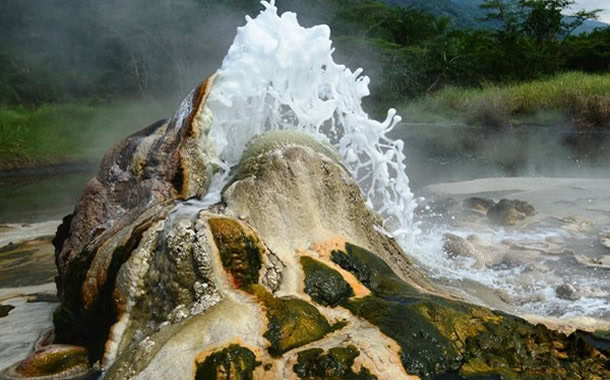
Sempaya hot springs are one of the most popular attractions in Semuliki National Park. The government gazetted Semuliki as a national park in 1993. It lies in Bundibugyo District in western Uganda, covering 220 square kilometers of land containing diverse flora and fauna. The Park is under the management of Uganda Wildlife Authority.
Two rivers flow on the borders of this park – River Semuliki and River Lamia. They have for many years been thirst-quenching spots for wildlife within the park. Semuliki has mainly two hot springs, of which Sempaya hot springs are part. It’s common to come across hundreds of birds around these hot springs. Because of their history, the cool grounds contain fairly large salt particles that animals within the park lick.
About Sempaya hot springs.
They register hundreds of tourists annually. People alternatively refer to them as Semuliki hot springs because they are located within the park. There are many birds and butterflies around these hot springs during the day, and a couple of monkeys that come around to lick salt and drink warm water as it cools on its way to the nearby valleys. As we approach the actual site, we smell hydrogen sulfide released by the hot vapor escaping from the boiling water of the hot springs.
Uniqueness.
The first major unique feature is their boiling levels. This is significantly higher than that of Kitagata hot springs, another wonderful feature in western Uganda. This therefore creates a rare scenery for tourists. Sempaya hot springs are grouped as ‘female and male’ and are surrounded by distinct vegetation, which is important in differentiation. The hot springs boil at extreme temperatures beyond the normal boiling point 103° Celsius.
Scientific formation.
Intrinsic Earth activities formed the hot springs by creating cracks in the Earth’s crust. These cracks allowed water to seep into the Earth’s interior near the magma, where heat and pressure built up and forced the heated water back onto the Earth’s surface. The process is continuous because water flowing within the Earth’s crust keeps finding its way to the hot Earth points. The geothermal heat is so much that the water is extremely hot, causing burns on any human skin.
The hot rocks in the Earth’s crust are barely prone to volcanic activity, which makes the area a safe zone for tourism. The road constructors who constructed the Fort Portal-Bundibugyo highway named the hot springs
They were mainly Swahili speakers who referred to the area as “Sehemu Mbuya.” The words translated into English mean “Difficult place.” The locals heard something different, and to them, the word was “Sempaya.” Since then, this name gained popularity.
Cultural beliefs behind the formation of Sempaya hot springs.
The Bamaga people, a group of people near these hot springs, have in their folklore a belief that sometime in olden times, they spotted a strange man who held a spear and was in the company of a dog in the forest that makes up Semuliki. Being a welcoming community, they invited the stranger to come and stay with them in their village, from which he married a woman.
However, he was soon not to be seen again after he went hunting, and only his spear was later found at the hot spring area that’s now known as the “male hot spring.” His wife, on learning the news, found her way to the forest to trace her husband, but would soon disappear and was never traced again.
The point at which she disappeared came to be known as the “female hot spring.” As a consequence of those events, the tribesmen have to date held a belief that their ancestors lie underground, beneath these 2 hot springs. They hold and perform cultural rituals annually around the sites to appease their ancestors.
Other activities within Semuliki National Park include:
Game drives.
Semuliki National Park is a savannah grassland area and therefore accommodates different wildlife mammals. Game drives are therefore a popular activity therein around animals such as forest elephants, antelopes, primates, and forest buffalo. The terrain of Semuliki National Park is also favorable for 4×4 cars that visitors use to navigate the park.
Birding.
As already noted, there are many bird species that fly above Semuliki National Park. There are mostly water birds due to wetland regions that dominate the Semuliki Valley. Shoebill, Marabou storks, eagles, herons, African forest kites, papyrus gonolek, among others.
Nature walks.
Semliki national park has several nature trails from which tourists walk and view the glorious beauty of the Semuliki Valley. These also introduce visitors to birding as they are well paved along bird-dominated parts of this park.
[…] The list for best parks to visit further scales through to places like Kidepo Valley National Park, Semuliki National Park, Lake Mburo National Park, and Pian Upe Wildlife Reserve, among many other […]