
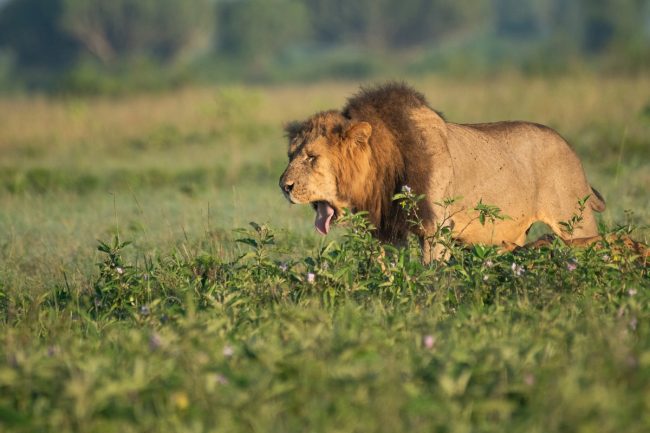
Experiential lion tracking in Uganda is the process of tracking and monitoring lion prides in their natural environments. This activity of experiential lion tracking is usually for research purposes, but can also be done for adventure. Spotting and encountering a pride of lions while on a safari is every visitor’s dream.
As it is with nature, it is not always a possibility to encounter lions on a safari. This is because nature dictates this luck since these lions roam the savannah freely. However, one thing is for sure, and that’s the excitement and adventure lions give to visitors upon spotting them. Since encountering lions on a safari is more of a probability, experiential lion tracking affirms the encounter.
Experiential lion tracking is not just about adventure, it is also an educational opportunity. This is because this activity is done with researchers who monitor and record the behaviours of lions. This provides a way for visitors to gain much knowledge about the behaviours of lions.
The experience of lion tracking breaks the usual rules of African game drive safaris by going off track to find the lions. Driving off track into rugged terrains and lush savannah grassland plains through woodlands gives visitors a more intimate experience. Experiential lion tracking is a conservation and protection method of monitoring and identifying the prides of lions.
Brief history of this experience
It is not long since the experiential lion tracking experience was started in Uganda. The Uganda Wildlife Authority started it to facilitate the conservation efforts of big cats, especially the lions. The research body of the Uganda Wildlife Authority, the then Uganda Large Predator Project, was started as a research body to study and monitor lions in the 1990s.
This was after an epidemic affecting lions had broken out in Tanzania, and the government feared it would spread here in Uganda. This assumption was affirmed after several lions started to die mysteriously in Queen Elizabeth National Park. Fortunately, it was later cleared that these lions were poisoned by the locals due to wildlife and human conflict reasons.
This research program grew and censored communities and was later renamed the Uganda Carnivore Program. It was tasked to protect the lions and also the people in the communities and their livestock from the lions. The program monitors and alerts communities on the behaviours of lions and how to coexist with them.
Experiential lion tracking was introduced as a way to train scientists and researchers. But it was started mainly to support the conservation efforts of the program through the costs generated. Therefore, every visitor to this experience participates in the conservation efforts of lions.
Where is experiential lion tracking done?
Experiential lion tracking is only done in Queen Elizabeth National Park. This is because this part has one of the largest populations of lions. At the same time, the wildlife and human conflict is at a much higher prevalence, with lions being more affected. The experiential lion tracking is specifically done in the Kasenyi sector of Queen Elizabeth National Park. It is one of the major tourist activities in the park.
This park is located in the western region of Uganda, covering the districts of Kasese, Kamwenge, Rukungiri, and Rubirizi. Queen Elizabeth National Park was established in 1952, formerly after the visit of Queen Elizabeth II. The park has a predominantly savannah grassland vegetation with scattered woodlands and forests. It measures about 1,978 square kilometers. This makes it the second biggest park in the country after Murchison Falls National Park.
How much does it cost?
The costs of experiential lion tracking in Uganda vary depending on the nationality of the visitors. The costs are separated along these lines of the originality of the visitors. The following are the costs of experiential lion tracking.
Foreign non-residents – USD 500
Foreign residents – USD 300
Rest of Africa – USD 300
East Africans – UGX 250,000
As mentioned earlier, these costs are vital as they are used in funding the conservation efforts of lions.
Is experiential lion tracking safe?
Yes, experiential lion tracking is very safe for visitors. You don’t need to worry about your safety when embarking on this experience because we’ve got you covered. Safety has never been a question but rather a priority. During this venture, visitors are assured of their safety.
This is because this experience is done in the safety and comfort of a safari vehicle and also under the guidance of researchers and armed rangers. All safety procedures are taken during this activity for both the lions and the visitors.
How is experiential lion tracking done?
Upon payments and confirmation of the receipts and permits, researchers armed with radio antennas join visitors in safari vehicles to begin the experience. Some of the lions in Queen had a GPS collar around their necks put earlier for monitoring, and these are the targets.
Drive towards the direction of strong radio signals from the GPS on the collar tags of the lions, identifying where the lions are. Visitors then observe the lions for a relatively period while watching their behaviours and studying them by the help of the researchers.
What is the best time to do experiential lion tracking?
Experiential lion tracking can be done anytime of the year, but the best time is always the dry season. This adventure of lion tracking is an off-track experience therefore, it requires ideal conditions. The dry season offers just that, with little showers and relatively hot and warm temperatures.
Such conditions ensure that the park remains very dry and most definitely navigable even during off-tracking. This season also offers better visibility with the sparse vegetation caused by the little or no rainfall patterns. The dry season is experienced from June to August and December to February.