
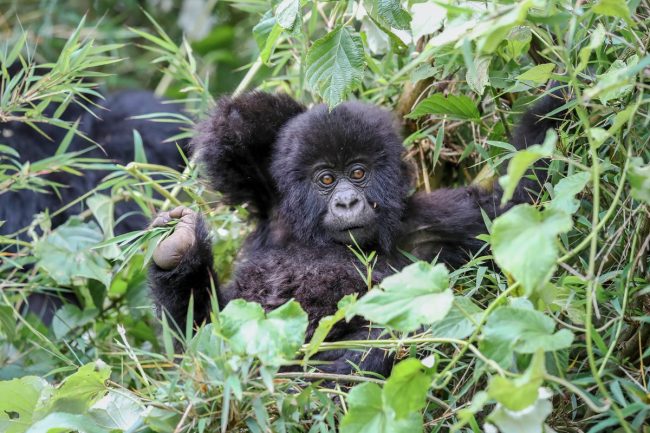
Rwanda is open for gorilla trekking at any time of the year, provided there is availability of permits. However, the best time for gorilla trekking in Rwanda is the dry season. The conditions in the dry season in the country are perfect for gorilla trekking.
This is because these conditions align well to favor this particular activity. Rwanda experiences an equatorial or tropical type of climate. This is because of the proximity to the imaginary line of latitude, the equator, which runs above the country. This type of climate pushes Rwanda to experience two dry and wet seasons per year.
The dry seasons in Rwanda run from June to September and from December to February. The dry season in Rwanda is a period of relatively low and comfortable humidity with small rotational patterns of scattered showers or rains. This means the dry season, as the name suggest is predominantly a time of prolonged dryness in the weather.
The wet season, on the other hand, is directly opposite to the dry season. The wet season in Rwanda lasts for two partners the short wet season, which is experienced from October to November, and the long wet season, which runs from March to May. During this time of the year, Rwanda experiences prolonged heavy showers and very cool temperatures.
Why is the dry season the peak gorilla trekking season in Rwanda?
Many factors point out the vast reasons why the dry season is the most ideal and best time for gorilla trekking in Rwanda. Below are some of these reasons.
Easy navigation
The first characteristic of the dry season in Rwanda is the dry atmosphere. Rwanda’s terrain, especially the gorilla destination, is hilly and mountainous. This means it is characterized by steep slopes.
The dry season provides a dry atmosphere ensures that the trekking trails are very dry. This ensures a quick and smooth navigation during the gorilla trekking experience in Rwanda. This makes the dry season an ideal time to have a gorilla trekking adventure in Rwanda.
Good visibility
The dry atmosphere experienced in the dry season deprives the forest vegetation cover of the much-needed rainfall for growth. Thus, this leaves the forest with sparse vegetation, which eases the visibility of the mountain gorillas even in the dense undergrowth.
The dry season ensures that there is good visibility for the visitors to encounter these primates in their natural environment. The sparse vegetation also eases navigation across the trekking trails while searching for the mountain gorillas. All these conditions team up for a favorable time of gorilla trekking in the dry season.
Activeness of the gorillas
The dry environment in the gorilla habitat not just favor the gorilla trekking, but is also enjoyed by the mountain gorillas. Mountain gorillas are much more active in the dry season since the conditions in their habitats are dry with a comfortable humidity. Visitors have a chance to encounter these primates actively playing and feeding during this time of the year.
This is like how it would be in the wet season, where the temperatures are low, making the mountain gorillas coil around each other for warmth. Such conditions of the wet seasons hinder the mobility and activeness of the gorillas. The dry season offers a much livelier mode of activity in the gorillas, making the trekking experience adventurous and exciting. It surely affirms why the dry season is the most ideal time.
Where is gorilla trekking done in Rwanda?
Rwanda is widely known as a gorilla destination, and Volcanoes National Park is where gorilla trekking is done. Volcanoes National Park is the country’s most popular protected area since it harbors mountain gorillas.
This park is located in the northern region of the country, bordering Uganda and the Democratic Republic of Congo. Volcanoes National Park is among the oldest parks in Africa, as it was established in 1925. This park is home to over 300 mountain gorillas living in 12 gorilla families or groups.
Gorilla trekking in Volcanoes National Park begins with a short pre-trek briefing. This briefing takes place at the park headquarters and is done by the head guide ranger. This briefing takes visitors through the basics of gorilla trekking. This includes the rules and regulations of this activity.
It is here that gorilla trekking permits are also scanned before embarking on this adventure. Visitors are further grouped into groups of 8 people and assigned a gorilla family. Each gorilla family is tracked by 8 people per day to avoid stressing these primates.
Gorilla trekking in Volcanoes National Park takes between 2 and 6 hours, depending on where the assigned gorilla family is. Gorilla trekking in this park during the dry season is less challenging, thus exciting when gorillas are encountered. An hour is awarded to the visitors in the presence of the mountain gorillas upon locating them.
How much is gorilla trekking in Rwanda?
The question of the costs of gorilla trekking in Rwanda highlights the prices of gorilla permits. A gorilla permit is a document that allows visitors to access the park and participate in gorilla trekking. The gorilla permits are priced in variations based on the origin and nationality of the visitors.
Foreign non-residents pay USD 1,500, foreign residents and visitors from the rest of Africa pay USD 500, and East Africans, including Rwandans, pay USD 200. This price is sent by the Rwanda Development Board, a governing body in charge of all the protected areas in the country.