
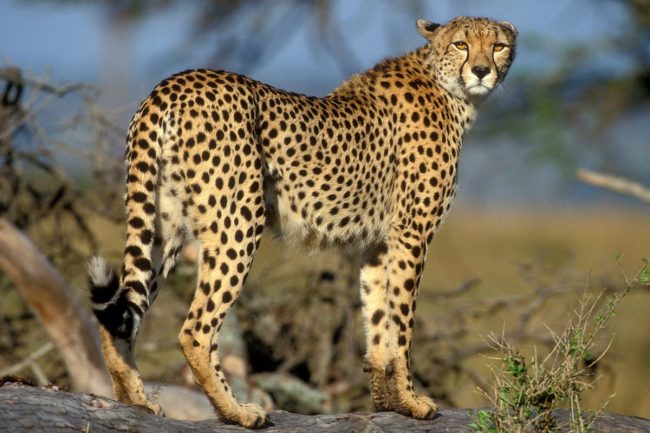
This is one of the most billion dollar question often asked by our clients, and yes, cheetahs are found in Uganda. The wildlife diversity in Uganda is totally unmatched, with incredible quality, as it has a bit of everything. Cheetahs are among the big cats that roam the savannah grassland plains with epic stealth and speed.
Where to see cheetahs in Uganda?
On average, Uganda lies about 1,100 meters above sea level, with 50% of the country forested and mountainous. This pushes the country to have limited savannah plains that are perfect for cheetahs. Nevertheless, Uganda’s extreme northern region is relatively flat and offers perfect sightings for cheetahs. Below are the areas in Uganda where to see cheetahs.
Kidepo Valley National Park
Approximately 20-30 cheetahs are recorded to inhabit Kidepo Valley National Park. Located in the northern Karamonja region on the border with South Sudan, Kidepo is the furthest park in the country. The Narus Valley and the Kidepo Valley are both regions and sectors in this park where cheetahs have been sighted. Cheetahs, like most big cats, are rare animals to spot, given they often hide from the hot temperatures of the day and are perfect to hunt when it’s cool.
Kidepo Valley National Park spans across 1,442 square kilometers of open savannah grasslands. Among the big cats inhabiting Kidepo, cheetahs are the most commonly spotted. This is because, unlike their cousins, the lions and leopards, which depend on stealth and strength to hunt, cheetahs use speed. Lions and leopards prefer to hunt in the dark when the sun goes down due to their excellent night vision and stealth. Cheetahs, on the other hand, prefer the bright day to chase their prey. This is why, among the big cats in this park, one is likely to catch a cheetah in action.
Pian Upe Game Reserve
Gazetted in 1964, formally as Debasien Animal Sanctuary, Pian Upe is another area in Uganda where cheetahs are found. Pian Upe is located in the eastern region of Uganda, just north of Mountain Elgon. Pian Upe’s vast area is predominantly a plateau with massive savannah grasslands and scattered woodlands.
Among the many mammals in this reserve, cheetahs are one of them. Although there may not be a specific record number of cheetahs in this reserve, there have been multiple sightings of these cats. This is highly attributed to their elusiveness and the solitary nature of their cheetahs. However, with excellent trackers and guides, one can surely spot cheetahs in Pian Upe Game Reserve.
Abilities and uniqueness of a cheetah
Cheetahs are ranked among the most successful killers among big cats in Africa. This is highly attributed to their marvellous ability to be the fastest land animal on Earth. Cheetahs can move from 0 to 100 kilometers per hour in under 3 seconds. Cheetahs can reach up to 120 km/h as their top speed. This means you blink twice and miss the action.
As it is with nature, one cannot have everything. What the cheetah has in speed, it lacks in strength. This is why the cheetah targets smaller or medium-sized prey like the Uganda kobs, impalas, oribis, and waterbucks, among others. The cheetah’s speed, it means that it has to cool off first before it can feast. In such cases, cheetahs most likely lose about 80% of their killers to big predators like hyenas, lions, and leopards.
Just like all other big cats in Africa, lions, leopards, and cheetahs live and thrive on the open savannah grassland and woodland plains. Their ability to run at top speeds means that they need a wider space to open in. This is why the African savannah is the perfect habitat for the cheetahs.
Cheetahs are generally solitary animals, just like leopards. This means they are not social and usually survive alone. However, there are some instances where male cheetahs form coalitions to fight and hunt together. Thus, coalitions increase their success rate in hunting down their prey and offer protection in numbers.
Conservation and protection of cheetahs
Cheetahs are unfortunately listed among the endangered species in the world, as they appear on the IUCN red list as vulnerable. Their endangerment is mostly because of poaching and habitat loss. All these man-made causes have put the fastest land mammal on Earth to the verge of extinction.
Uganda, in collaboration with other international conservation organizations like the Cheetah Conservation Fund, has explored methods and ways to protect these cheetahs. However, it is not just such organizations that fund the conservation of these cheetahs alone. Tourists from across the world pay to spot these cheetahs in their natural habitats. A huge percentage of their payments goes to funding the conservation efforts of protecting cheetahs.
Sustainable tourism is also core to conserving the future of the cheetahs. This is because sustainable methods of tourism help in preserving the environment, which is the major habitat of these cheetahs. In conclusion, cheetahs can be spotted in Uganda while on a game drive in Kidepo Valley National Park and Pian Upe Game Reserve.