
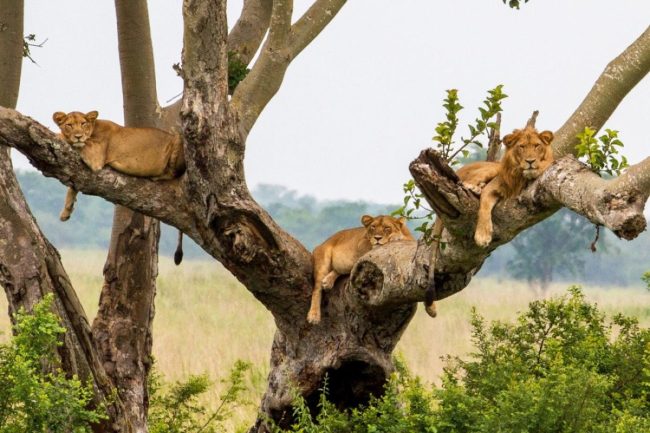
By the sound of this tree-climbing behaviour of lions, most would deem it unreal and just fictional talk. Because, how do you explain Africa’s biggest cat and the most dangerous to be able to climb trees, crazy right, well it’s not. The fact that lions climb trees means there would be no place for prey to hide anymore. Well, this is not just hearsay; it is actually a reality to the lions in the Ishasha sector of Queen Elizabeth National Park. Wow, this only explains the abundance of attractions and incredible wildlife that lies beneath the eye in Uganda’s uncharted savannah.
The nature of these lions
From history and science, lions by nature are not climbers and are not built for it either. However, with many underlying factors that scientists have yet to identify, lions of Ishasha have adapted to climbing trees. This is an act that is natural to their cousins, the leopards.
This spectacular phenomenon of lions climbing trees is a delicacy for the Ishasha sector in Queen Elizabeth National Park. However, this spectacle is shared with Tanzania’s Lake Manyara National Park. This park also has sightings of the tree-climbing lions. As much as this is the case, Ishasha remains the leading destination to spot these lions high up in the trees.
Just like in social learning with humans, cubs learn to climb trees in Ishasha through modelling and imitating the adult lions as they climb. This is short to say that lions are not born with the ability to climb trees. It is not in their system by nature, and that’s why cubs struggle to perfect it. The tree-climbing lions in Ishasha are the major reason why visitors tour this sector, and they are the face or identity of this whole Ishasha region.
As mentioned, lions don’t have an instinct to climb trees, and this is evidenced by many other lions in other parks in the country, like Murchison Falls and Kidepo Valley, and other areas like Serengeti and beyond. Therefore, this tree-climbing behaviour in the lions of Ishasha can be attributed to survival and probably imitation.
Why do lions in Ishasha climb trees?
There isn’t much supporting evidence and facts as to why lions in Ishasha climb trees. However, some myths explain this behaviour and seem close to factual. But the mystery and adventure are what make this experience absolutely incredible. Below are some of the myths that explain the tree-climbing behaviour in the lions of Ishasha
Escape biting ground insects.
Lions in Ishasha developed a tree-climbing behaviour to escape biting ground insects. The African savannah is a land indoctrinated in the fight for survival. Everything can be harmful to anything, and the king of the jungle is also not spared. Ground level, itchy biting insects like the savannah ants deliver some of the most painful bites. Low-flying insects, such as tsetse flies, can also be irritating to lions. In an attempt to escape such depressing conditions, the tree-climbing behaviour of the lions of Ishasha evolved.
Avoid the ground heat.
The tree-climbing lions in Ishasha adapted this behaviour to avoid and escape the heat on the ground. The Ishasha sector, situated in the southern region of Queen Elizabeth National Park, receives strong heat, especially in the dry seasons. This is because the park is crossed by the equator, and the sun is always strongest overhead. This heat makes the ground unbearable for the lions, forcing them to find alternative means high up in the trees.
High ground to spot prey
The lions’ instinct to hunt pushed them to find high ground to spot prey. This is because Ishasha as a sector is relatively flat with very tall savannah grasslands, making it hard to spot prey on the ground. With tree-climbing lions, they have a much better vantage point to spot prey even from a distance.
Minimize the danger on the ground.
The savannah is a world full of threats from every angle. Lions minimize the danger or threats when they are high up in the trees. Buffaloes are the lions’ most well-known nemesis and are known to kill more lions in Africa than any other wildlife species. With lions in the trees, they are much safer and protected from the dangerous horns of buffaloes.
An abundance of fig trees
The Ishasha sector has an abundance of fig trees scattered across its vast ecosystem. These fig trees are very comfortable with big branches that lions’ favorite to climb. These trees have smoother backs with wide branches and are quite high. These trees offer a perfect hideout for the lions to scan their territory.
What to see in Queen Elizabeth other than the tree-climbing lions?
Queen Elizabeth National Park is situated in the western region of Uganda. The park is the most popular destination in the country. It covers about 1,978 square kilometers, stretching through the districts of Kasese, Rubirizi, Rukungiri, and Kamwenje. It was named after the Queen of England, commemorating her visit in 1954, just two years after it was established. Below are some of its untamed attractions, leaving out the tree-climbing lions in Ishasha.
Chimpanzees
Many seem to forget that Queen Elizabeth National Park actually hosts chimpanzee primates. These primates can be encountered on a chimpanzee trekking experience in the Kyambura Gorge. Chimpanzees are among the most intelligent species, sharing over 98% DNA with humans.
Birdlife
This park is gifted with over 500 bird species, with some writers putting the number as high as 600. This means that Queen Elizabeth hosts the most bird species in the country and is the place to spot these species. There are both migratory and resident species. The park’s ranging ecosystems help to nest these birds. Some of these birds include the African fish eagle, papyrus gonolek, cuckoos, African crown eagle, vultures, African pied, sunbirds, and crested cranes, among others.
Wildlife species
The park also harbors large numbers of wildlife species like elephants, buffaloes, Uganda kobs, waterbucks, warthogs, leopards, spotted hyenas, hippos, and crocodiles, among others. These wildlife species can be spotted on a game drive and boat cruise experience in the park.
Tree-climbing lions in Ishasha can be spotted lounging in the acacia and fig trees on hot days. The dry season presents more chances of spotting these lions, but the wet season is also ideal for encountering them. Contact us at Monteero Safaris as we craft your adventure to the tree-climbing lions in Ishasha.
[…] across the country can connect easily from Queen Elizabeth’s Ishasha sector, popular for the tree-climbing lions. This sector tells a connecting blend from the animated savannah grassland and woodland to the […]
[…] lion cub in the Ishasha sector sets the bar even higher because this is the introduction of a new tree-climbing lion. However, with the birth of this cub, more conservation efforts need to be put in place. This is […]