
Purchasing a gorilla permit is an easy and fast experience provided you use a trusted and registered tour company, like Monteero Safaris. A gorilla permit is issued by the Uganda Wildlife Authority to the tour operator immediately after payments are made. The process of purchasing a gorilla permit starts with the visitors confirming the dates they wish to trek. Then the tour operator searches the dates and confirms the availability. The payments then follow through streamlined and trusted channels like bank accounts.
After this, the tour operator then purchases the gorilla permit from the Uganda Wildlife Authority. As an accountability and transparency measure, the purchased permit is scanned, and a copy is sent to the client or visitor as confirmation of the purchase. It is important to note that the purchase of gorilla permits is reserved for the local tour companies and not individuals.
These tour companies must be registered with the Uganda Tourism Board for proper monitoring and accountability. The reasons why the purchase of a gorilla permit is reserved for tour companies are to reduce the middlemen and fraudsters. The registration and business numbers of each tour company are displayed on the UTB website for visitors to confirm eligibility.
What is a gorilla permit?
A gorilla permit refers to a document that allows visitors to access a particular gorilla destination for gorilla trekking. The purchase of this gorilla permit gives visitors a once-in-a-lifetime opportunity to walk in the footsteps of other greats side by side with the mountain gorillas. Due to their nature, mountain gorillas live in the highlands in extremely steep terrain.
This means they can only be accessed on foot. Therefore, this gorilla permit is the only assurance that visitors will search for these mountain gorillas and have an hour with them after locating them. A gorilla permit is very important in assuring that a limited number of visitors are allowed to visit a particular gorilla family per day. Only 8 gorilla permits are issued for a single gorilla family per day.
What is gorilla trekking?
Gorilla trekking refers to the act of venturing into the deep jungles of different gorilla destinations for a chance to encounter the mountain gorillas. During gorilla trekking, visitors are given an hour to spend with these primates after encountering them. The process of gorilla trekking is a complex activity that stretches even the most experienced hikers.
This is because the mountain gorillas, as their name suggests, live in highland or mountainous areas. These areas are often very steep and have dense thickets that hinder navigation and mobility. Ranger guides help to create trails by cutting and forcing their way through the thickets.
And this is not even the hardest part about gorilla trekking yet. You see, with highland or mountainous areas, there is steep terrain. This steep terrain poses the biggest challenge to the visitors. Navigating this rugged, steep, and dense terrain can be straining and equally exhausting. Relief comes when the mountain gorillas are finally encountered, and adrenaline of excitement calms the tired body.
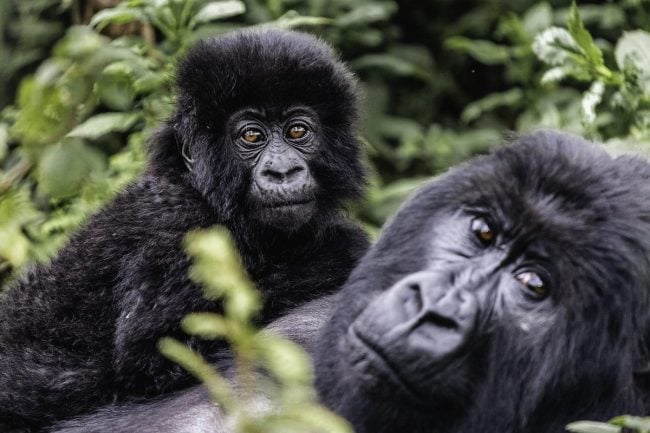
Mountain gorillas are very social beings that live in groups that are called gorilla families. These families are headed by a male gorilla called a silverback. In a single gorilla family, there could be more than one silverback, the dominant and leader of the group is always one. Mountain gorillas share a close resemblance to humans, with a 98% DNA similarity.
Where to see mountain gorillas in Uganda?
The pearl of Africa, Uganda, has made its name by rising to the ranks as the undisputed gorilla destination in the world. This explains why there is a high up turn of visitors every year. There are only two gorilla destinations in Uganda where these primates can be seen, and these are:
Bwindi Impenetrable National Park
In the heart of Uganda’s coldest region, in the misty highlands of Kigezi in the southwestern region, Bwindi Impenetrable National Park rises. A hero born through years of conservation and constant monitoring, Bwindi is among the few bears the last population of mountain gorillas in the world. Documented as an unmatched gorilla destination, Bwindi Impenetrable National Park has been a gorilla habitat for many years, established in 1991.
This remarkable achievement made this 331 square kilometer gorilla haven a center of the world for gorilla conservation. With Bwindi at its peak, UNESCO recognized and named it a World Heritage Site in 1994. This naming breathed new life into new opportunities, rising to its best. This name not only hosts the mountain gorillas, but also the flora species that date back over 25,000 years.
Bwindi Impenetrable National Park has a proud growing population of 459 mountain gorillas. This is the largest population of mountain gorillas in a single destination. With over 1,063 mountain gorillas left in the wild, over half of them live in Bwindi. The park is divided into four different sectors, i.e., Buhoma, Rushaga, Ruhija, and Nkuringo. These sectors harbor a significant number of gorilla families. The park has over 50 families, but half of them are habituated and available to trek.
The park forms a continuation of the Virunga Conservation Area, the last known habitat of mountain gorillas. This conservation area stretches from the Democratic Republic of Congo through Uganda and Rwanda.
Mgahinga Gorilla National Park
Mgahinga Gorilla National Park is the gorilla destination in the Virunga Conservation Area. The southwestern region of Uganda could be the most gifted area in the country. From hosting Bwindi to Mgahinga Gorilla National Park at the border with Rwanda. It is the second gorilla destination in the country and the smallest park.
Over 100 mountain gorillas roam the 33.9 square kilometers of this secret jungle, with just one gorilla family. Mgahinga has long been known as the sleeping giant, tender at most with lucking in size, but doubling in adventure. Just like its counterpart, Bwindi, Mgahinga was recognized as a UNESCO site in 1994. This was just four years after it was established as a national park.