
Queen Elizabeth National Park is situated in the western region of Uganda. It spans across the districts of Kasese, Kamwenge, Rubirizi, and Rukungiri. This park has a large land area of about 1,978 square kilometers.
Queen Elizabeth National Park stands at its peak as the most popular national park and protected area in Uganda. This affirmation is guaranteed by a phenomenon of events and years of leading this lane.
Several top attractions in Queen Elizabeth National Park have pushed this park to this peak. Borrowing facts from history, Queen Elizabeth National Park has been a top destination, hosting some of the greatest figures in history. And such visits of great figures are highly attributed to these top attractions.
Top attractions in Queen Elizabeth National Park
There is no doubt that Queen Elizabeth National Park is the leading park in hosting many visitors per year. This is definitely attributed to the top attractions this park offers. Such attractions affirm the park’s slogan as a medley of wonders. Below are some of these top attractions.
Tree-climbing lions
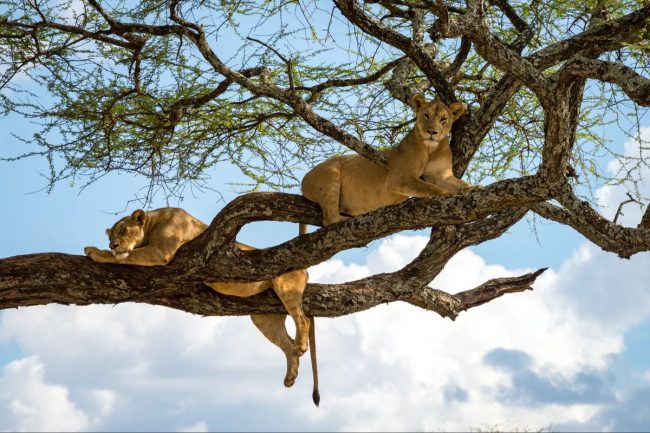
The tree-climbing lions in Queen Elizabeth National Park are considered the major attraction in the park. Although the reason as to why this fact in lions to climb trees remains a mystery, one thing is for surely it is electric. The tree-climbing lions are rare in the whole continent, and only two places have been confirmed to have them. One place is Lake Manyara National Park in Tanzania, and Queen Elizabeth National Park is the next one.
These tree-climbing lions in Queen are located in the Ishasha sector of the park. Every day, several visitors flock to the park seeking to spot these lions. At one moment on a game drive in Ishasha, visitors can spot and be amazed by how lions have rewritten the rules of the wild and effortlessly climb trees.
Chimpanzees
Chimpanzees are also a major attraction in Queen Elizabeth National Park. The biodiversity of Queen Elizabeth National Park shocks even the most experienced travellers. Who would have thought that a savannah destination could actually have an area of tropical rainforest enough to host chimpanzees?
Surely no one could have imagined this factor other than those who have visited and witnessed Kyambura Gorge in Queen Elizabeth National Park. Popularly known as the Valley of Apes, Kyambura is the one place in the park that hosts chimpanzees.
Wildlife species
Queen Elizabeth National Park also hosts other wildlife species. These include even the most sought-after species like the Big Five. The park hosts four of the Big Five animals, including lions, elephants, buffaloes, and leopards. The rhino is the missing animal for a full round-up of the Big Five.
Other animals to spot in the park include hyenas, Uganda kobs, waterbucks, warthogs, hippos, baboons, etc. The vast nature of the park creates an abundance of pasture, and constant water sources make it an ideal place for the wildlife.
Birds
Hosting over 600 bird species, Queen Elizabeth National Park is a popular destination for birds. The park has a wide range of vegetation and ecological systems that include tropical rainforests, savannah grassland, and woodland. These systems provide the best nesting areas for these bird species. The park hosts both the migratory species, seen in specific seasons, and the endemic resident species that are constants of the park.
Some of the bird species in the park include African masked warbler, African emerald cuckoo, black coucal, yellow bill, African fin foot, knob billed duck, African jacana, yellow wagtail, shoebill, sacred ibis, black crake, white-breasted nigro-finch, chestnut wattle eye, marsh tchagra, and black bishop, among others.
Kazinga Channel
Kazinga Channel is another top attraction in Queen Elizabeth National Park and is visibly noticed. This channel is the main water source for the wildlife species in the park. The Kazinga Channel is a waterway that connects Lake Edward and Lake George.
This channel is an important part of Queen Elizabeth National Park’s biodiversity. This is because it hosts the aquatic life of the park. The channel harbors countless Nile crocodiles and over 5,000 hippos, making it the largest population of hippos in the country. The channel also offers beautiful sightings of most animals as it is their popular meeting point.
Crater Lakes
Queen Elizabeth National Park is also a geographical marvel, hosting over 10 crater lakes. These crater lakes are scattered across the park, making them an important attraction. Most of these crater lakes produce natural chemicals that are useful to the wildlife. These crater lakes were formed a million years ago from a volcanic eruption. Some of the crater lakes in Queen Elizabeth National Park include Lake Katwe, Bunyaruguru, and Ndeli Kasenda Craters.
Brief history of Queen Elizabeth National Park
As we talk about the top attractions in Queen Elizabeth National Park, we need to first understand a bit of the history of this park. It is such history that highlights the understanding of this park’s position globally as a popular destination. The history of Queen Elizabeth National Park usually starts at the time of its establishment or gazetting as a protected area. However, its history stretches further than that.
The year is 1921, and a disease breaks out in the then areas of the current Queen Elizabeth National Park. Then, this area was occupied by the Basongola people with their livestock. This disease outbreak led to their death and also their livestock. With such an overwhelming situation, these people fled this area. In the years that followed, the colonial government further pushed people from their land to create room for the expansion of the parkland.
Lake George and Lake Edward Game Reserves were later combined and designated the whole area as one wildlife protected area. In 1952, this area was established as a national park and named Kazinga National Park.
In 1954, the Queen of England, Queen Elizabeth II, visited the park. To commemorate her visit, the colonial government changed the name of the park to Queen Elizabeth National Park. The park is now managed by the Uganda Wildlife Authority.