
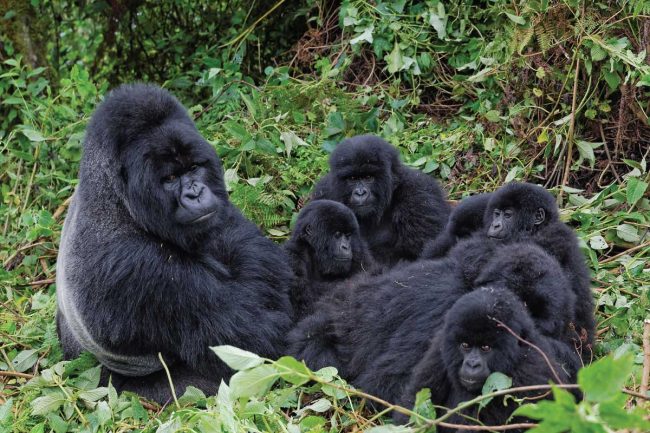
Bwindi Impenetrable National Park continues to expand its conservation success with new habituated gorilla families. The park already has almost half of the mountain gorilla population on earth, sheltering them in its diverse habitats. There are 4 gorilla sectors where visitors can track and see these gorilla families in Bwindi: Ruhija, Nkuringo, Rushaga, and Buhoma. The new habituated gorilla families enhance trekking diversity. They include,
Posho Gorilla Family
The Posho Gorilla Family is composed of 17 members within the Nkuringo Gorilla Sector. Posho is led by the dominant silverback Magara. The 17 members in the Posho Gorilla Family comprise 1 silverback, 8 adult females, 2 sub-adult females, 2 juveniles, and 4 infants. The name Posho is derived from the literal ‘posho,’ also known as ‘Ugali’ in Swahili. This was the daily meal of the trackers during the habituation of this gorilla family.
Muyambi Gorilla Family
The Muyambi gorilla group, with 7 members, thrives in the Buhoma Gorilla Sector. With Muyambi as the leader, the group is composed of 1 silverback, 4 adult females, and 2 infants. Trekking the Muyambi gorilla group offers deeper insight into the members’ complex social dynamics and behaviors. You get to learn about how this group split from the Mubare group in 2019, and what followed after this.
Bikingi Gorilla Family
The Bikingi Gorilla family lives in the Rushaga Gorilla sector and got its name from the previous dominant silverback, Bikingi. Now, the Bikingi Gorilla family is under the leadership of the dominant silverback Kaharata. There is an exciting story of how Kaharata got to this position. He was solitary before fighting Bikingi. Both had been involved in a series of epic fights before Kaharata killed Bikingi. At the moment Bikingi gorilla family has 12 members. They include 2 silverbacks, 5 adult females, 1 juvenile, and 4 infants.
Binyindo Gorilla Family
The Binyindo Gorilla Family has only 9 members and is found in the Buhoma gorilla sector. The leader is also known as Binyindo, a name that alludes to his unique nasal features. Binyindo is responsible for a family composed of 1 silverback, 5 adult females, 2 juveniles, and 1 infant. The Binyindo Gorilla Family is among the newest groups to be habituated in Bwindi Impenetrable National Park.
Rwigi Gorilla Family
This is another newly habituated gorilla family within the Rushaga Gorilla Sector. The Rwigi Gorilla Family is led by the dominant silverback, also called Rwigi. This formed as a result of fierce conflicts that caused the splitting away from the Kahungye Gorilla Family. Right now, the Rwigi Gorilla Family is composed of 10 members. These comprise 1 silverback, 5 adult females, 2 juveniles, and 2 infants.
Tindatine Gorilla Family
Opened for gorilla trekking tours in the year 2024, which makes the Tindatine family among the newest. This group likely broke away from the Kahungye gorilla family within the Rushaga Gorilla Sector. This group is still found within Rushaga and consists of 7 members, including the dominant silverback.
Duration of a gorilla trek in Bwindi
The way gorilla trekking is done in Bwindi Impenetrable National Park follows a standardized approach among all habituated families. Trekking each of the mentioned families, among others, takes between 2 to 6 hours. This includes the 1 hour allocated for viewing once the gorillas are encountered. This is because the family you are trekking might have nested either close to or far from the starting point. Also, the pace at which you walk is significant in determining how long the trek will take.
Price of a gorilla trek in Bwindi
In Bwindi Impenetrable National Park, the price of trekking is standardized but varies across 4 distinct categories.
- Foreign non-residents: USD 800 per person
- Foreign residents: USD 700 per person
- Rest of Africa: USD 500 per person
- East African Community Citizen: UGX 300,000 per person
Actually, these rates are used for purchasing a gorilla permit. You present this document at the park headquarters before you are allowed into the forest to track a habituated gorilla family. Each gorilla permit paid for covers the cost for guiding, entrance to the park, and a contribution to community development.
How to buy gorilla permits?
It is mandatory to purchase all gorilla permits from the Uganda Wildlife Authority only through a registered tour operator. Monteero Safaris is one such trusted operator authorized to facilitate any gorilla trekking permit to Bwindi Impenetrable National Park. Visitors should contact us, and it is much better if they do so at least 3 months before the activity. This is due to the limited gorilla permits offered for sale per day.
There is high demand for them, which makes acquiring extremely competitive. You must contact us with all the necessary information, including the day of the trek. Provide the details on your national identity card, which are meant to be legitimate. Also, you must be at least 15 years old to be eligible for gorilla trekking tours in Bwindi Impenetrable National Park. You can find us on our website, social media platforms, phone, or WhatsApp 24 hours a day of the week.
When to do a gorilla trek in Bwindi?
Gorilla trekking in Bwindi Impenetrable National Park is not limited by calendar dates. This is a year-round experience offered to visitors daily. You can trek gorillas in Bwindi Impenetrable National Park either in the wet season or the dry season. We encourage tracking gorillas during the latter because it offers fewer challenging conditions for trekking. The skies are clearer, gorilla trails are less muddy/slippery, and the vegetation is less dense due to low rainfall patterns.
The months that coincide with the dry season are usually June to August and December to February. For the hardcore travelers who love quite challenging trekking conditions, the wet season is meant for you. Despite the heavy rains received in Bwindi Impenetrable National Park during this season, trekking is still doable. You just have to be physically fit to navigate the muddy/slippery gorilla trails covered by thick vegetation. You should also brace yourself for increased chances of heavy rains that might interrupt your trek.